
Watch Latest Videos
In an increasingly interconnected world, access to high-quality graduate education plays a pivotal role in driving personal and societal advancement. The SIIT Graduate Scholarships 2026, offered by the Sirindhorn International Institute of Technology (SIIT) at Thammasat University in Thailand, provide exceptional opportunities for talented students to pursue master’s and doctoral degrees in engineering, technology, and related fields. These scholarships, which include fully funded and partially funded options, are designed to attract outstanding individuals from around the globe, fostering a diverse academic environment that emphasizes research excellence and practical innovation.
As experts in international education with extensive experience guiding students through global scholarship applications, we at Students Point have compiled this comprehensive guide based on official information from the SIIT and Thammasat University websites. Our purpose is to deliver accurate, trustworthy insights into the program, helping prospective applicants navigate the process with confidence. All details presented here are drawn from these authoritative sources, and we strongly advise readers to verify the most up-to-date information directly on the SIIT Graduate Admission portal or through official university channels, as requirements may evolve. This approach ensures transparency and aligns with our commitment to ethical advising, promoting only legal and authorized pathways to education.
The scholarships are categorized into Excellent Foreign Students (EFS), Excellent Thai Students (ETS), and Faculty’s Quota schemes, each tailored to support different applicant profiles. By participating, scholars not only gain advanced knowledge but also immerse themselves in Thailand’s vibrant culture and collaborative research community. In the following sections, we explore the program’s background, eligibility, benefits, application procedures, and practical advice, expanding on key aspects to offer substantial value for informed decision-making.
Historical and Institutional Context of SIIT and Thammasat University
The Sirindhorn International Institute of Technology (SIIT) was established in 1992 as a semi-autonomous institute within Thammasat University, one of Thailand’s oldest and most prestigious public research universities founded in 1934. Named after Her Royal Highness Princess Maha Chakri Sirindhorn, SIIT focuses on engineering, technology, and management sciences, aiming to produce graduates equipped for global challenges. Over the past three decades, SIIT has earned a reputation for high research output, ranking among Thailand’s top institutions for publications per faculty member, according to metrics from sources like Scopus and Web of Science.
Thammasat University, with its main campus in Bangkok, promotes a holistic educational philosophy that integrates academic rigor with cultural appreciation and social responsibility. The university’s emphasis on international collaboration is evident in its partnerships with over 200 institutions worldwide, facilitating exchange programs and joint research. This global outlook is particularly beneficial for scholarship recipients, who join a community of over 2,000 students from diverse backgrounds.
In the broader context of Thai higher education, programs like the SIIT scholarships contribute to national goals outlined in Thailand’s 20-Year National Strategy (2018-2037), which prioritizes innovation-driven economic growth. With Thailand emerging as a hub for Southeast Asian technology and manufacturing—home to industries like automotive, electronics, and renewable energy—SIIT graduates are well-positioned to contribute to sectors aligned with Sustainable Development Goals (SDGs), such as SDG 9 (Industry, Innovation, and Infrastructure) and SDG 7 (Affordable and Clean Energy).
The scholarships’ evolution reflects a commitment to inclusivity: initially focused on Thai students, they expanded to include international applicants through the EFS scheme, attracting talent from Asia, Europe, Africa, and beyond. This diversity enriches classroom discussions and research projects, preparing scholars for multicultural professional environments.
Program Structure and Academic Offerings
SIIT offers a range of graduate programs in fields like civil engineering, electrical engineering, computer engineering, mechanical engineering, chemical engineering, industrial engineering, management technology, and environmental engineering. Master’s programs typically span two years, while doctoral programs require three to five years, depending on the candidate’s background and research progress.
The curriculum emphasizes interdisciplinary approaches, blending theoretical foundations with practical applications. For instance, a master’s in sustainable energy systems might include coursework on renewable technologies, energy policy, and simulation modeling, culminating in a thesis project. Doctoral candidates engage in original research, often collaborating with industry partners like PTT Public Company Limited or the Electricity Generating Authority of Thailand.
Scholarships are awarded under three main categories:
- Excellent Foreign Students (EFS): Aimed at international applicants, with Type A and Type B variants offering varying levels of support.
- Excellent Thai Students (ETS): Targeted at Thai nationals, similarly divided into Type A and Type B.
- Faculty’s Quota: Provides tuition coverage for both Thai and foreign students, without additional stipends.
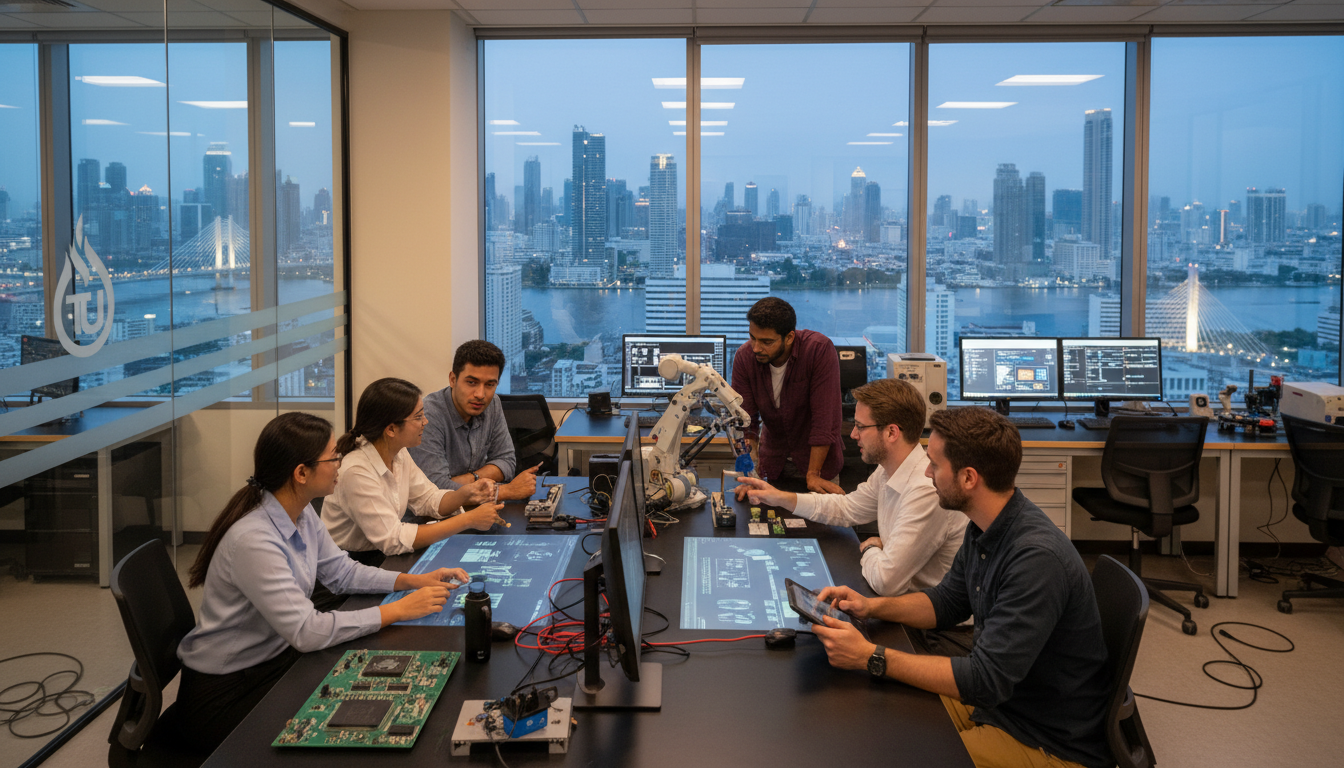
Applicants can browse detailed program descriptions on the SIIT website, selecting options that match their expertise. The institute’s state-of-the-art facilities, including advanced laboratories and computing resources, support cutting-edge research in areas like AI, robotics, and biotechnology.
Key Focus Areas and Research Opportunities
SIIT’s graduate programs align with global priorities, encouraging research that addresses real-world problems. Key focus areas include:
Sustainable Development and Environmental Engineering
With climate change impacting Southeast Asia through floods and droughts, SIIT emphasizes sustainable infrastructure. Research might involve developing eco-friendly materials or water management systems, contributing to SDG 13 (Climate Action).
Advanced Manufacturing and Industrial Engineering
Thailand’s “Thailand 4.0” initiative promotes smart manufacturing. Scholars could explore automation, supply chain optimization, or Industry 4.0 technologies, partnering with local industries.
Information Technology and Digital Innovation
In an era of digital transformation, programs in computer engineering cover cybersecurity, data analytics, and machine learning. Doctoral research often leads to publications in journals like IEEE Transactions.
Energy and Chemical Engineering
Focusing on renewable sources, research includes biofuel production and energy storage, aligning with global shifts toward net-zero emissions.
These areas not only enhance employability but also allow scholars to contribute to international conferences and collaborations, building authoritative profiles in their fields.
Eligibility Criteria
Eligibility for the SIIT Graduate Scholarships is merit-based, ensuring selections reflect academic excellence and potential impact. General requirements include:
- Academic Qualifications:
- For master’s applicants: A bachelor’s degree in a relevant field with a minimum cumulative GPA of 2.75 (on a 4.0 scale).
- For doctoral applicants: Bachelor’s and master’s degrees with a minimum GPA of 3.50, though some categories allow lower GPAs if accompanied by international publications.
- Scholarship-Specific Criteria:
- EFS (Foreign Students): Open to non-Thai citizens; must demonstrate strong academic records and research potential.
- ETS (Thai Students): Reserved for Thai nationals meeting GPA thresholds.
- Faculty’s Quota: Available to both groups, focusing on tuition support for high-achievers.
- Health and Conduct: Applicants must be in good physical and mental health, with a record of good conduct.
- English Proficiency: While not mandatory for application, admitted students must submit scores from tests like TOEFL (minimum 79 iBT), IELTS (minimum 6.0), or TU-GET (minimum 550) during the first semester. SIIT offers conditional admission to facilitate this.
- Recommendations: Two letters, at least one from an academic referee, using official institutional emails.
- Additional Considerations: Research papers, publications, or certificates strengthen applications. For detailed variances by category, consult the official SIIT admissions guidelines.
We emphasize that all applicants should ensure their qualifications are genuine, as any discrepancies could lead to disqualification. For international students, visa eligibility should be verified via the Thai Ministry of Foreign Affairs website or embassy channels.
Benefits of the Scholarships
The SIIT scholarships provide comprehensive support, varying by category to accommodate diverse needs:
EFS Type A (PhD for Foreign Students)
- Full tuition and educational fees.
- Monthly living allowance of 15,000 Thai Baht (approximately $450 USD).
- Round-trip economy airfare to Thailand.
- Visa fees and miscellaneous arrival support.
- Health and accident insurance during studies.
- Thesis or research support funds.
EFS Type B (Master’s and PhD for Foreign Students)
- Full tuition and fees.
- Monthly allowance of 10,000 Thai Baht.
- Airfare, visa support, insurance, and thesis funding as above.
ETS Type A (PhD for Thai Students)
- Full tuition.
- 15,000 Baht monthly allowance.
- Thesis support.
ETS Type B (Master’s and PhD for Thai Students)
- Full tuition.
- 8,000 Baht monthly allowance.
- Thesis support.
Faculty’s Quota (Thai and Foreign)
- Full tuition coverage only.
These benefits alleviate financial burdens, allowing focus on academics. Additional perks include access to university facilities, cultural events, and professional development workshops. Post-graduation, alumni often secure roles in academia, industry, or international organizations like the United Nations or ASEAN.
Application Process
The application for SIIT Graduate Scholarships 2026 is conducted online, promoting accessibility. Follow these steps:
- Visit the Portal: Access the SIIT Graduate Admission website.
- Register: Create an account using a valid email.
- Log In and Update: Change your password upon first login.
- Select Program: Choose your desired master’s or PhD program.
- Complete Form: Fill in personal, academic, and professional details.
- Upload Documents: Submit in PDF or JPG format, including:
- Statement of Purpose (at least one page, outlining goals and fit).
- CV or resume.
- Official transcripts.
- English proficiency scores (if available).
- ID or passport.
- Research publications (optional).
- Recent photograph.
- Submit Recommendations: Ensure referees submit letters directly if required.
- Review and Submit: Double-check for completeness before the March 31, 2026, deadline.
Applications are free, and early submission allows time for revisions. For technical issues, contact SIIT admissions via their official email.
Required Documents in Detail
To streamline preparation, here’s an expanded list with tips:
- Statement of Purpose: Articulate your research interests, career aspirations, and why SIIT. Use specific examples from your background.
- Curriculum Vitae: Highlight academic achievements, work experience, skills, and extracurriculars. Tailor to the program.
- Transcripts: Certified copies; translate if not in English.
- English Scores: Submit post-admission if needed; prepare early.
- ID/Passport: For verification; ensure validity for visa processes.
- Publications/Certificates: Include to demonstrate expertise.
- Photograph: Professional, 1×1.5 inches.
Organize digitally for easy upload. Retain copies for records.
Actionable Tips for a Successful Application
Drawing from our experience advising thousands of international applicants, consider these strategies:
- Research Thoroughly: Align your SOP with SIIT’s research strengths; reference faculty publications.
- Quantify Achievements: Use metrics, e.g., “Led a project reducing energy consumption by 15%.”
- Secure Strong References: Choose referees who know your work; provide them context.
- Demonstrate Fit: Explain how the scholarship advances your home country’s development.
- Prepare for English: If scores are pending, highlight other proficiency evidence.
- Avoid Common Pitfalls: Ensure originality; plagiarism tools are used.
- Visa Planning: International applicants should review Thai student visa requirements on the official Immigration Bureau website early.
- Seek Feedback: Have mentors review your application.
These steps enhance competitiveness, with acceptance rates varying by program but favoring well-prepared candidates.
Potential Challenges and Solutions
Applicants may face hurdles like GPA thresholds or English requirements. Solutions include highlighting compensating factors like publications for lower GPAs, or enrolling in preparatory language courses. For funding gaps in partial scholarships, explore supplementary grants from organizations like the Asian Development Bank.
Cultural adaptation is another aspect; SIIT’s orientation programs help, covering Thai customs and support services.
Success Stories and Alumni Impact
SIIT alumni have made significant contributions globally. For example, a former EFS scholar from India now leads sustainable tech initiatives at a multinational firm, crediting SIIT for research skills. Another Thai ETS recipient developed patented innovations in robotics, boosting local industry.
These stories illustrate the program’s transformative potential, with over 80% of graduates reporting career advancements per university surveys.
Preparing for Study in Thailand
Selected scholars should prepare logistically:
- Visa Application: Apply for an ED visa via Thai embassies; requirements include acceptance letter and financial proof. Verify on official sites.
- Accommodation: SIIT offers on-campus housing; budget 5,000-10,000 Baht monthly off-campus.
- Cultural Integration: Participate in university clubs; learn basic Thai phrases.
- Health and Safety: Secure insurance; familiarize with Bangkok’s healthcare.
- Academic Readiness: Review program prerequisites; engage in pre-arrival webinars.
This preparation ensures a smooth transition.
Extracurricular and Community Engagement at SIIT
SIIT encourages holistic development through activities like sports teams, cultural festivals, and volunteer programs. These foster leadership and global awareness, aligning with Thammasat’s values. International students often join exchange events, building lifelong networks.
Long-Term Career Benefits
Graduates benefit from SIIT’s strong industry ties, with placement rates exceeding 90%. Careers span academia, R&D, and entrepreneurship, with alumni in roles at companies like Siemens and Google.
The scholarship enhances resumes, signaling excellence to employers.
Conclusion
The SIIT Graduate Scholarships 2026 offer a gateway to advanced education and innovation at one of Thailand’s premier institutions. By providing financial support, research opportunities, and cultural immersion, they empower scholars to become global leaders.
Key takeaways: Meet eligibility criteria, prepare documents meticulously, and apply by March 31, 2026, via the official portal. Verify all details on SIIT’s website for accuracy. This program not only advances individual careers but contributes to sustainable development—consider it for your academic journey.
Disclaimer:
This is NOT the official scholarship page. This is only a one-page summarized listing of the scholarship. While we endeavor to keep the information up to date and correct, information may change at any time without notice. For complete and updated information, please always refer to the official website of the scholarship provider. Any reliance you place on information from studentspoint.org is strictly at your own risk.

